題目出處
難度
easy
個人範例程式碼
class Solution:
    def strStr(self, haystack: str, needle: str) -> int:
        if haystack <mark> None or needle </mark> None: # input handling
            return -1

        for i in range(len(haystack)-len(needle)+1): # bounding, O(n)
            if (self.compare_strstr(haystack[i:i+len(needle)], needle)):
                return i

        return -1

    def compare_strstr(self, part_of_haystack, needle): # O(m)
        return part_of_haystack == needle
算法說明
字串比對字串,很簡單的處理
(最近在練習程式碼本身就可以自解釋的 Coding style,可以嘗試直接閱讀程式碼理解)
input handling
注意沒有輸入的時候的處理,
這裡要特別小心,「if not X」,會因為在Python中,None、False、0、""(空字符串)、、()(空元組)、{}(空字典) 都相當於 False 而出錯,
我們需要特別抓出「None」來判斷,因此我們必須要寫
if haystack <mark> None or needle </mark> None: # input handling
而不能寫
if not haystack or not needle:
Boundary conditions
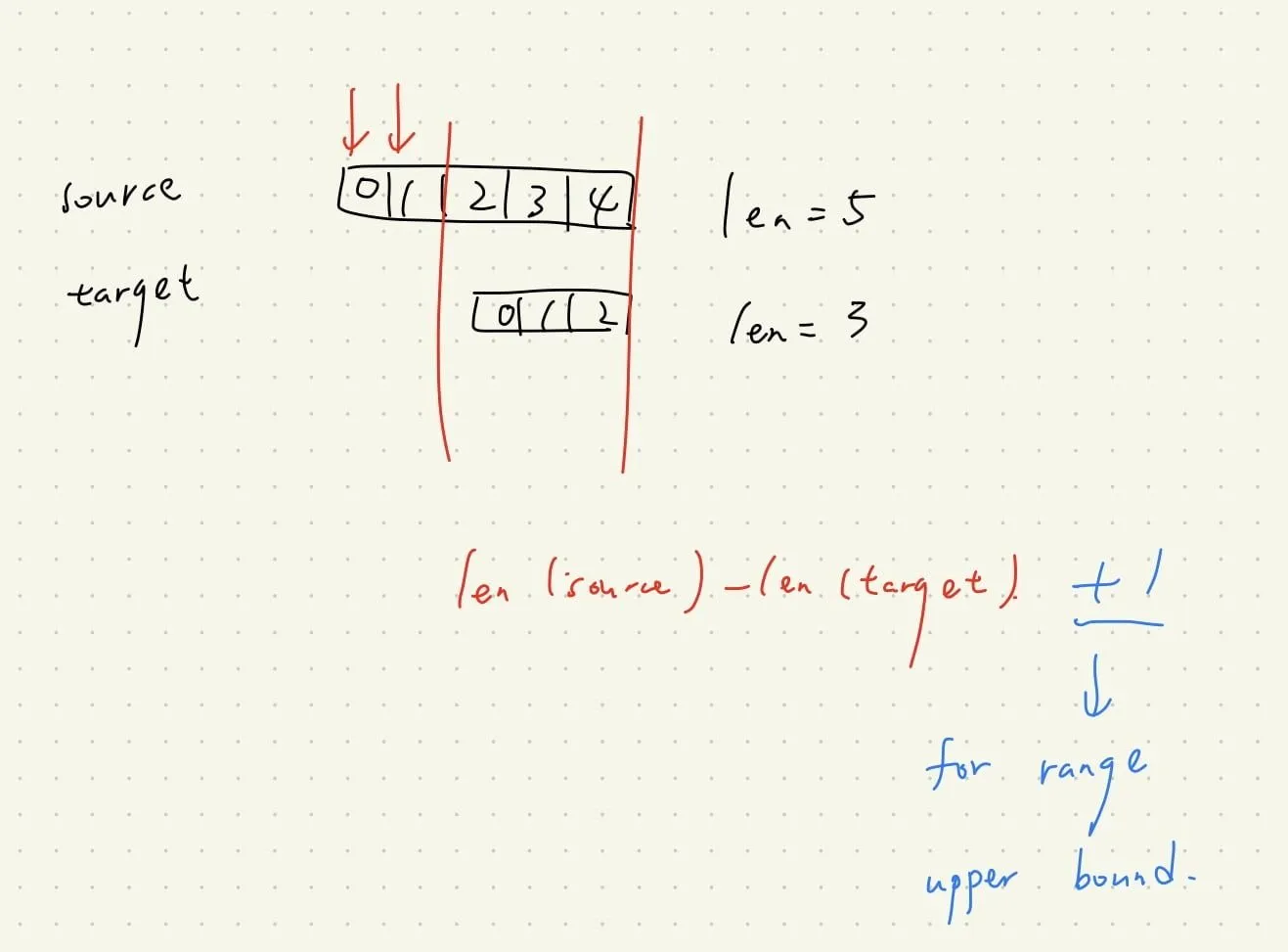
本題最小的搜尋範圍為 len(source) - len(target),
而因為 range 的語法關係,有 upper bounding 需要 +1
因此範圍為 「for i in range(len(haystack)-len(needle)+1): # bounding, O(n)」
補充 - 此題最佳算法為 KMP 演算法 O(n)
我上述舉的例子為 O(mn),但這題的最佳作法為 KMP 演算法,
但由於目前階段還沒有想要鑽研特定項目到太深,這個特殊作法日後再來補