題目出處
309. Best Time to Buy and Sell Stock with Cooldown
難度
medium
個人範例程式碼
class Solution:
    def maxProfit(self, prices: List[int]) -> int:
        if len(prices) <= 1:
            return 0

        buy = [0 for _ in range(len(prices))] # max profit, if buy today or not
        sell = [0 for _ in range(len(prices))] # max profit, if sell today or not
        cooldown = [0 for _ in range(len(prices))] # = sell[i-1]

        buy[0] = -prices[0] # init

        for i in range(1, len(prices)):
            cooldown[i] = sell[i-1]

            # if sell yesterday(or before) is max, or sell today will max
            sell[i] = max(sell[i-1], buy[i-1]+prices[i])

            # if buy yesterday(or before), or buy today will max
            # sell & cooldown both keep current max profit
            buy[i] = max(buy[i-1], cooldown[i-1]-prices[i])

        return max(cooldown[-1], sell[-1])
最近在練習程式碼本身就可以自解釋的 Coding style,可以嘗試直接閱讀程式碼理解
算法說明
要考慮滿多東西的 DP 問題,算是買賣股票系列問題中的複雜版
我們先定義主要的 DP
- buy: 代表至當日若有任何買入,可獲得的最大 profit (可能是在 今日 或 n天前 買入)
- sell: 代表至當日若有任何賣出,可獲得的最大 profit (可能是在 今日 或 n天前 賣出)
- cooldown: 固定等於 sell[i-1],是紀錄 sell 的 cooldown,供 buy 時參考
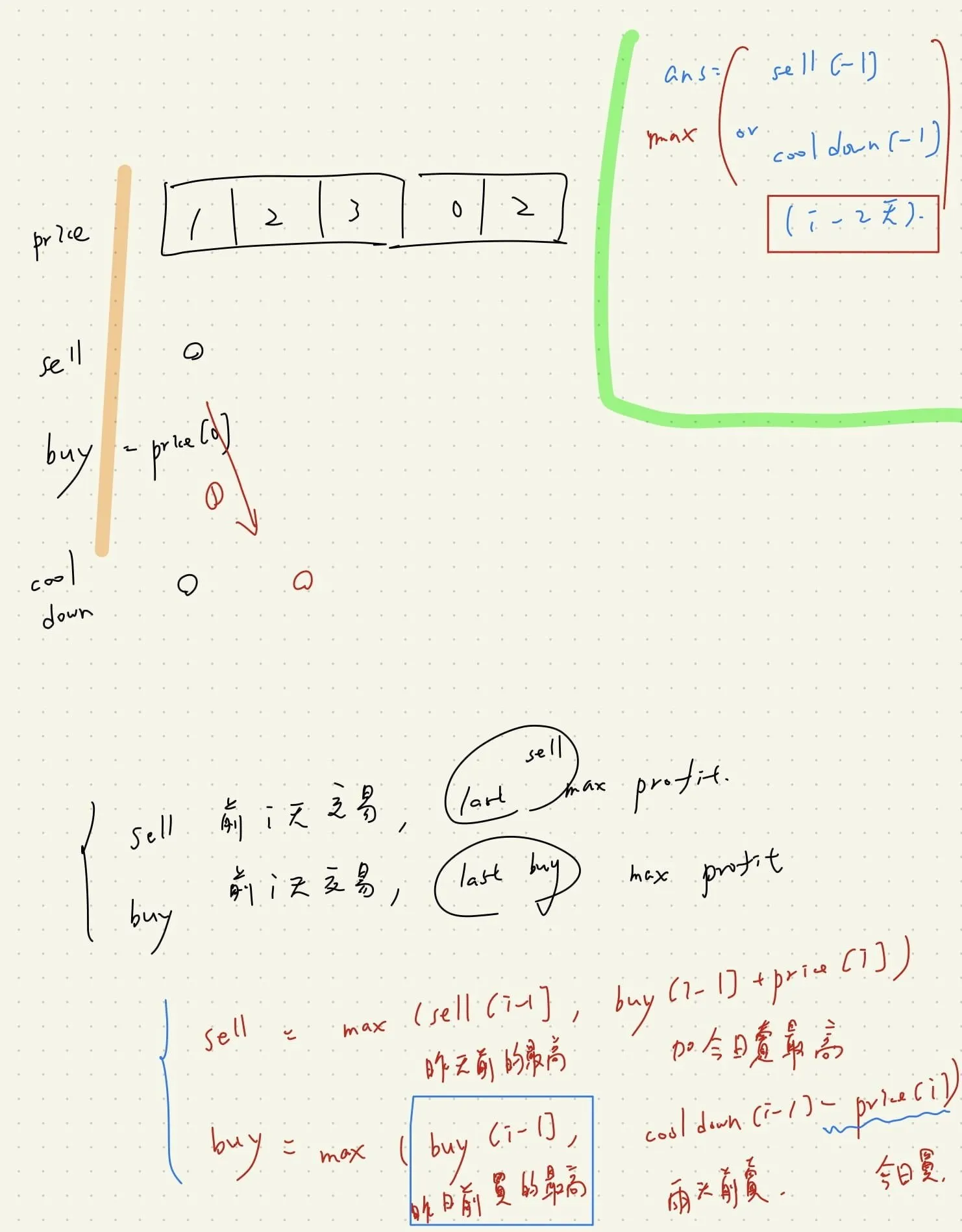
化成公式:
都有可能是今日不採取任何策略才是最好的情況,因此都會需要與昨日比較。
- buy[i] = max(buy[i-1], cooldown[i-1]-prices[i])
cooldown[i-1]-prices[i] 代表我們拿 sell 最大 profit,並在今日買入會更大
- sell[i] = max(sell[i-1], buy[i-1] - prices[i])
buy[i-1] - prices[i] 代表,在前 n 日買入時,在今日如果賣出,會得到更好的收益
- cooldown[i] = sell[i-1]
這邊我們要注意的事情是,
就算 sell 在當日選擇了賣出的策略較好,
但 buy 仍會記錄最好的買入價。
因此不會因為「今日先選擇了 sell 策略」,明日「只剩下 buy 的選擇」
例子
例如: 1,2,3
分析到 2 時,也許 sell 在當日是最好的 sell[2] 策略,
但其實 sell 在 3 才是最好的,這個訊息被記錄在 buy[2] 裡面,
我們可以在 sell[3] 知道從 buy[2] 獲得最大利益。
初始化
- buy[0] = -prices[0]
- sell[0] = 0
- cooldown[0] = 0
input handling
如果 len(prices) <= 1,return 0
只有小於一日,買入也是賠錢。
Boundary conditions
用 for 來控制搜尋範圍