題目出處
難度
Medium
題目分類
Array, Backtracking, Bit Manipulation
2026-10-09 三刷
個人範例程式碼 - 三刷 (2026/10/09)
class Solution:
    def subsets(self, nums: list[int]) -> list[list[int]]:
        ans = []
        end = len(nums)
        def dfs(start, path):
            if start == end:
                ans.append(path[:])
                return

            # no pick
            dfs(start+1, path)

            # pick (backtracking)
            path.append(nums[start])
            dfs(start+1, path)
            path.pop()

        dfs(0, [])
        return ans
算法說明
組合問題 (與 LC 77 題 是兄弟),可以對照參考。
簡單來說就是要做出 backtracking, append 與 pop 交替使用。
Time Complexity
O(n*2^n)
# 2^n:選或不選
# n: (小心,經常忘記) 複製的時間成本是 O(n)
Space Complexity
O(n) # 遞迴最大深度
2026-09-30 二刷
個人範例程式碼 - 二刷 (2026/09/30)
class Solution:
    def subsets(self, nums: list[int]) -> list[list[int]]:
        ans = []
        path = []

        def dfs(i):
            if i == len(nums):
                ans.append(path[:])
                return

            dfs(i+1) # not pick
            path.append(nums[i])
            dfs(i+1) # pick
            path.pop()

        dfs(0)
        return ans
算法說明
注意:這題經常會跟 LeetCode 77 (LC 77 Combinations 筆記) 搞混在一起,主要差別是結束條件不同
這題是所有子集 (2^n),LC 77 是所有組合 C(n, k) 不太一樣,但寫法很容易搞混。
主要就是透過 DFS,並在每一輪都有決定「選 or 不選」,組出所有的可能性。
Time Complexity
O(n*2^n)
- 2^n:所有的選與不選
- n:複製 path 需要 n 的時間
Space Complexity
O(n)
主要是遞回深度,最多 n 層 (所有數字)
2022-05-23 一刷
個人範例程式碼 - 一刷 (2022/05/23)
class Solution:
    def subsets(self, nums: List[int]) -> List[List[int]]:
        if not nums:
            return [[]]

        ans = []
        self.dfs(nums, 0, [], ans)

        # print(ans)
        return ans

        # []
        # [1] [12] [123]
        #     [13]
        # [2] [23]
        # [3]

    def dfs(self, nums, start, combination, ans):

        ans.append(combination[:]) # deepcopy

        # end of recursion
        # define and split (use or not use)
        for i in range(start, len(nums)):
            combination.append(nums[i])
            self.dfs(nums, i+1, combination, ans)
            combination.pop() # backtracking
最近在練習程式碼本身就可以自解釋的 Coding style,可以嘗試直接閱讀程式碼理解
算法說明
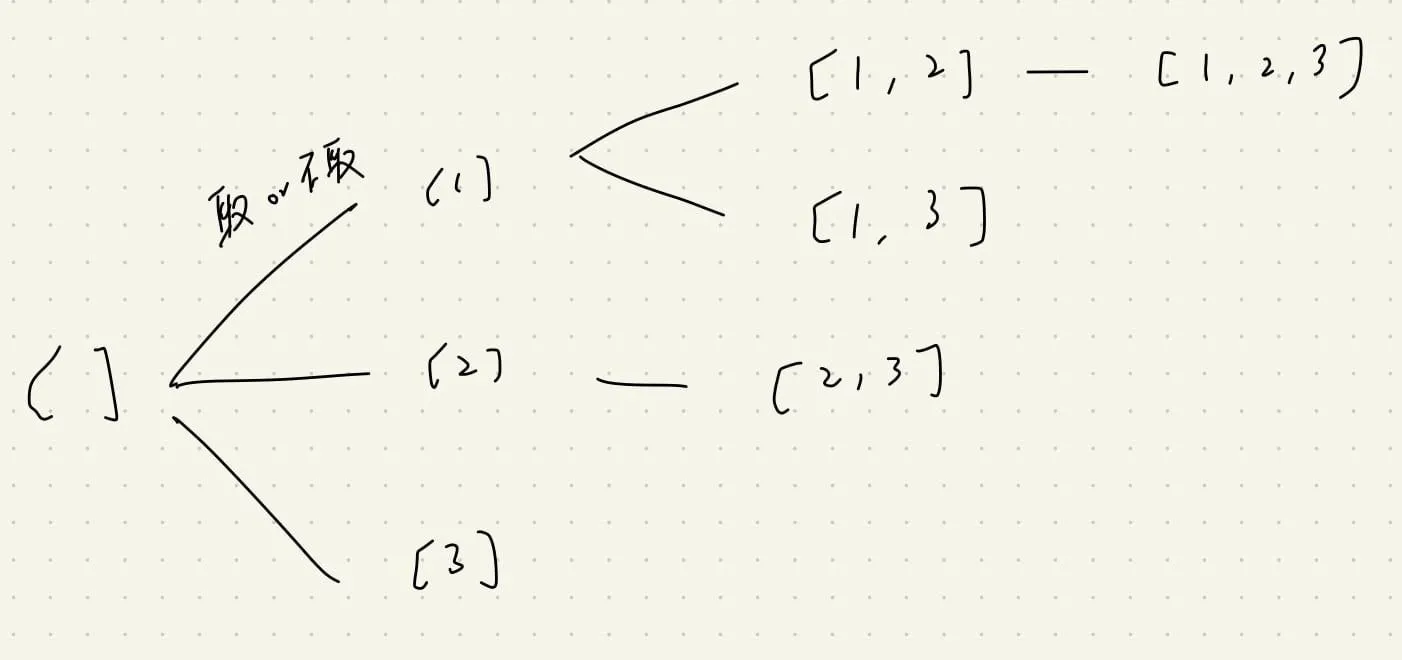
經典 DFS 的組合問題,思考方式如下:
每一層我們都可以決定「取特定數字或不取」,但取或不取,順序都要一直往後。
input handling
如果沒有 nums,return [[]]
Boundary conditions
用 dfs 內的 for loop 控制搜尋範圍